
Meet the Character: Chad from Summer Love Autumn Goodbye
Every other week, I’m bringing back my Meet the Character series and spending a little more time introducing the people behind my books.
Last time, we started with Marissa—the girl who started everything.
There was really only one person who could come next.
Chad.
This Meet the Character post is going to be different from most of the others because Chad didn’t begin as an idea in a notebook. I didn’t sit down one day and decide what his personality would be, what kind of past he should have, or what sort of person would make Marissa fall in love.
Chad existed long before Summer Love Autumn Goodbye did.
He was real.
And he was my first love.
Meet Chad
When Marissa meets Chad in Summer Love Autumn Goodbye, he isn’t exactly the person anyone would choose for the responsible teenage girl who normally follows the rules.
He’s older than her. He’s her cousin’s best friend. He’s recently been released from juvenile detention, he’s trying to get through school, and he’s already raising an infant son.
Basically, he’s complicated.
And Marissa falls for him anyway.
Chad has already made mistakes by the time readers meet him. He’s dealing with responsibilities most people his age aren’t prepared for while also trying to figure out his own life. Then Marissa walks into it.
Their relationship begins during one summer, but it doesn’t stay there. What starts as a summer romance becomes first love, and suddenly they’re trying to figure out what happens when summer ends and more than 200 miles separate them.
Neither of them has any idea just how much that relationship is going to change them.
The Parts We Don’t Like to Talk About
Chad’s life isn’t easy.
There are drugs. Violence. Loss. Trouble with the law. Bad decisions and consequences.
Those things aren’t in his story because I wanted to create a stereotypical “bad boy” for Marissa to fall in love with. They’re there because teenagers really do deal with those things.
Kids face drugs. Kids experience violence. Kids lose people who are important to them.
Kids get arrested. They make terrible decisions. They grow up in circumstances where the choices available to them aren’t always good ones. They can be dealing with grief, trauma, addiction, anger, and responsibilities they’re nowhere near ready for while still being expected to walk into school the next morning and act like everything is normal.
Sometimes we talk about teenagers as though their biggest problems should be homework, dating, sports, and figuring out what they want to do after graduation.
For some kids, that simply isn’t reality.
Chad knew that.
Some of the struggles in Summer Love Autumn Goodbye came from very real places. I didn’t need to invent a perfectly polished fictional tragedy because real life had already taught me that teenagers can be dealing with things the adults around them don’t fully see or understand.
That doesn’t mean every choice Chad makes should be excused. Understanding why someone is struggling isn’t the same as pretending their actions don’t have consequences.
But I think there’s a huge difference between saying someone did something wrong and deciding someone is nothing more than the worst thing they’ve ever done.
Chad was never just one thing.
He could make bad choices and still be loved. He could struggle with drugs and still be someone worth caring about. He could experience violence and loss and have no idea what to do with any of it. He could hurt people while also hurting himself. He could desperately need help and have absolutely no idea how to ask for it.
Sometimes the kid everyone has already decided is the “problem” is carrying problems nobody ever bothered to ask them about.
The Real Chad
This is where talking about Chad gets more complicated.
Because while Summer Love Autumn Goodbye is fiction, Chad wasn’t simply a character I created.
There was a real Chad.
We met when I was young, and he became my first love. We were together for a little over a year. There was about a three-and-a-half-year age difference between us, and looking back as an adult, I can recognize things about that relationship that I couldn’t understand when I was living it.
I don’t need to pretend it was a perfect relationship to acknowledge that it mattered.
Both things can be true.
I can look back with an adult perspective and recognize that some parts weren’t necessarily healthy or ideal while still acknowledging that I loved him and that losing him changed me.
On August 20, 1998, Chad died by suicide.
Six days later, I started high school.
I was young, grieving my first love, and trying to figure out how I was supposed to continue with normal teenage life when absolutely nothing felt normal anymore.
That loss stayed with me for a very long time.
In some ways, it always will.
Turning Something Real Into Fiction
Years later, when I wrote Summer Love Autumn Goodbye, I wasn’t trying to write a biography of my relationship with Chad.
Marissa isn’t me.
Book Chad isn’t an exact recreation of the person I knew.
The events of the novel aren’t a transcript of our lives.
But the emotions behind them came from somewhere very real.
First love came from somewhere real. Distance came from somewhere real. Some of the struggles came from somewhere real. And grief came from somewhere very real.
So did the experience of being far too young to understand how one person can suddenly be gone while the rest of the world somehow keeps moving.
Writing gave me somewhere to put some of that.
It allowed me to take emotions I’d carried for years and turn them into a story about love, loss, grief, and what happens to the people left behind after suicide.
That story eventually became the first book I published.
His Story Ends Here. His Impact Doesn’t.
Unlike Marissa, Chad doesn’t wander into the Self Inflicted Saga or show up again in #BeYourself.
His story belongs to Summer Love Autumn Goodbye.
But his impact doesn’t stop when the book ends.
You can see it in Marissa as she gets older and appears in my other books. What happened when she was young became part of who she grew into. She carries that history with her because grief doesn’t disappear simply because a particular story has reached its final page.
And, in a completely different way, the real Chad’s impact continued too.
Losing him played a huge role in shaping me. It influenced the kinds of stories I eventually became willing to tell. It influenced the way I write about suicide and the people left behind. It also influenced the way I write teenagers who are facing things we sometimes wish teenagers didn’t have to know anything about.
But wishing those things didn’t happen doesn’t make them disappear.
Kids struggle with mental health.
Kids self-harm.
Kids experience abuse.
Kids encounter drugs.
Kids experience violence.
Kids lose people they love.
Kids make mistakes.
And kids sometimes feel so completely alone in what they’re experiencing that they can’t imagine anyone else could possibly understand.
Pretending those things don’t happen to teenagers doesn’t protect them.
Kids don’t need us to pretend these things don’t happen. They need to know that if these things are happening to them, they aren’t the only one.
That belief eventually became something much bigger in my writing.
#YouAreNotAlone.
My books have gone on to deal with suicide, self-harm, abuse, mental health, grief, identity, and healing. They aren’t all Chad’s story—not even close—but I don’t think I would have become the same writer without having known and lost him.
More Than the Tragedy
There’s something else that’s important to me whenever I talk about Chad.
I don’t want his death to become the only thing that defines him.
Suicide is how he died.
It isn’t the entirety of who he was.
And I don’t want to clean up the rest of his life now that he’s gone, either.
Remembering someone after they’ve died doesn’t require turning them into a perfect person.
Chad struggled. He made mistakes. There were drugs. There was violence. There was grief and loss long before his own death became another loss for the people who loved him.
Those things were part of his life.
But they weren’t all of it.
He was a whole person, and whole people are complicated.
Before the grief, there was a person I loved. There were memories. There were good moments and complicated ones. There was a relationship that meant an enormous amount to a younger version of me.
That’s part of why writing about him can still be difficult even after all these years.
Grief changes as you get older.
I can look back now with perspectives I couldn’t possibly have had as a teenager. I can understand things differently. I can recognize complications younger me couldn’t see.
But none of that erases the person who existed or what he meant to me.
I don’t think healing requires us to rewrite our past into something simpler than it actually was.
Sometimes we just learn how to carry all of it.
The Boy Behind the Book
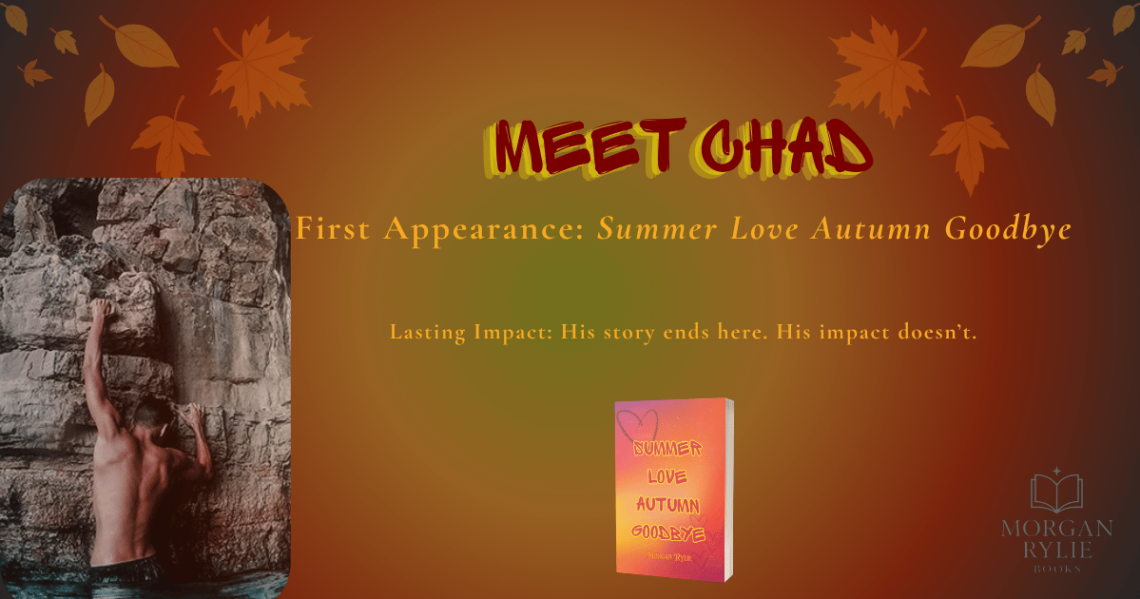
The graphic I made for Chad says:
His story ends here. His impact doesn’t.
I don’t think I could sum him up any better than that.
Book Chad’s story ends in Summer Love Autumn Goodbye, but Marissa carries pieces of that story forward.
The real Chad’s life ended far too young, but his impact became part of my own story.
And eventually, part of the reason I started telling difficult stories instead of pretending difficult things don’t happen.
So, meet Chad.
A character in Summer Love Autumn Goodbye.
A very real piece of my past.
My first love.
And someone whose impact reached much further than he ever could have known. 🖤
📖 Chad’s story begins and ends in Summer Love Autumn Goodbye.
You May Also Like

Character Spotlight: Meet Marissa, the Heart of Summer Love Autumn Goodbye

Character Spotlight: Meet Erik, Self Inflicted
